Lightweight Hardwood Panels for Marine Fit-Outs
Marine interiors reward a panel that is easy to carry, stable in humidity and pleasant to finish. Okoume answers all three: a pale red hardwood face, relatively low density for a hardwood panel, and a compliance route that includes CE EN13986 documentation with E1 and E0 low-emission glues. Here is where it fits in a fit-out specification.
Key takeaways
- Okoume is a low-density hardwood face, which shows up in handling as much as in the finished weight of a cabinet run.
- The face runs pale red to pinkish, with a uniform grain that accepts stains, laminates and clear sealers.
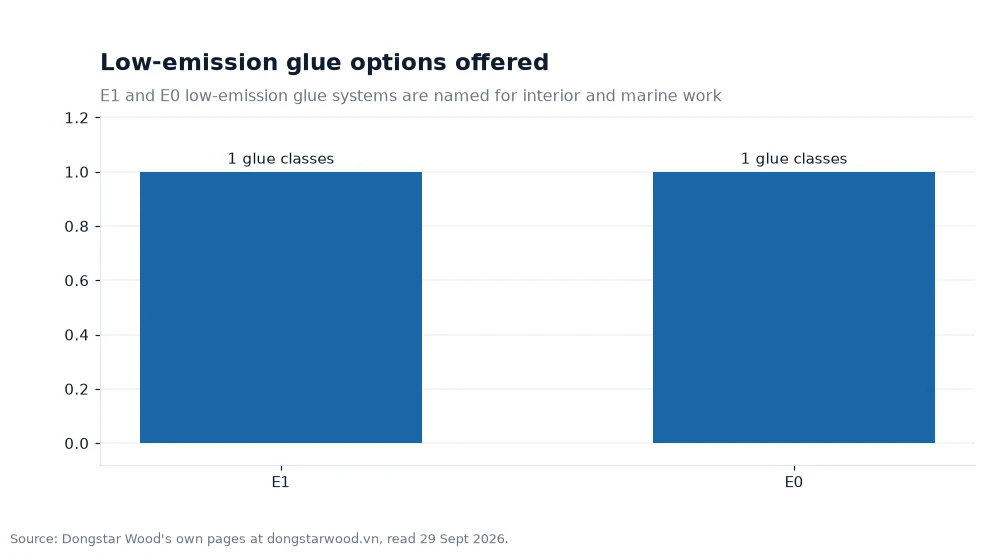
- Compliance options are published as CE EN13986 documentation with E1 and E0 low-emission glue systems.
- Calibrated veneers and tight thickness tolerance matter more than face appearance in a curved cabinetry build.
What makes okoume suitable for fit-out work
Fit-out schedules are unforgiving about weight. Every kilogram added to a bulkhead or a cabinet carcass is a kilogram the hull carries for its whole service life, so specifiers look for a hardwood face that behaves like a hardwood while weighing less than the denser alternatives.
Okoume's published description is exactly that: relatively low density compared with many hardwood panels, easier to handle on site, and dimensionally stable in service. That combination suits interiors where panels are cut and fitted by hand in a confined space, rather than craned into position by a contractor with heavy lifting equipment.
The applications follow the same logic. A Okoume Plywood Supplier spec sheet lists yacht cabinetry, boat interiors and lightweight structural elements for marine work, alongside interior panelling — wall cladding, ceiling panels and partitions — where the panel is seen rather than hidden behind a finish.
The pale red face and its uniform grain also decide what the panel is asked to do in a cabin. Doors, trims and decorative accents are cut from the same stock as carcass panels, so a specifier who fixes one face grade across the whole package avoids the surprise of a batch that matches nothing else on site. Where a joint will be visible, the lighter tone makes small tolerance differences less obvious than a darker face would.
Density, handling and dimensional stability
Low density does two jobs at once. It lowers the finished weight of a cabinet run, and it makes the panel easier to cut, carry and position in a cabin where two people cannot stand side by side. The second benefit is easy to underestimate until a fitter has to hold a full sheet against a bulkhead and mark it.
Stability protects the same benefit over time. A panel that moves with humidity gaps at the joints, and a gap in a marine interior is not only a visual fault — it is a place for moisture to collect. Species that hold their dimensions let a fitted joint stay closed through the seasonal humidity swings the vessel will see.
The pale red face and what it accepts
Okoume presents a natural hardwood face in a pale red to pinkish tone with a uniform grain structure. Uniformity is the useful part: a face with consistent grain takes stain evenly, so a clear sealer, a tinted lacquer or a laminate all end up looking deliberate rather than patchy.
That range of finishes is why the same panel serves visible cabinet doors and hidden carcass work. A lighter tone also lifts the interior of a cabin with limited natural light, which is a design consideration in yacht and boat fit-out, not only a matter of appearance.
| Property | Published description | Fit-out consequence |
|---|---|---|
| Density | Relatively low compared with many hardwood panels | Easier handling and less weight in the finished run |
| Face | Natural okoume veneer, pale red to pinkish tone, uniform grain | Even staining, lamination, painting and clear sealing |
| Compliance | CE EN13986 support; E1 and E0 low-emission glues | Interior air expectations and construction conformity |
| Construction | Calibrated veneers, precision pressing, tight thickness tolerance | Clean joints in curved and modular cabinetry |
| Sourcing | Okoume timber from sustainably harvested sources | Origin questions answered at quotation stage |
Compliance: CE EN13986 and low-emission glues
Two documents carry most of the compliance weight for interior panel work. CE EN13986 documentation supports the claim that a panel meets the harmonised standard for wood-based panels, and many manufacturers in this category support it. Low-emission glue systems then describe what the panel releases once it is installed.
E1 and E0 are the two classes named for okoume. In a closed cabin the emission question matters more than it does in a ventilated workshop, so the class belongs in the purchase order as a code rather than as a general assurance about air quality. Keep the batch reference against it as well.
Worked example: area and sheet count for a cabin package
Cabin fit-out is sized by surface, not by panel count. A standard 1220 × 2440 mm panel: 1.22 × 2.44 = 2.98 m², plus a 1250 × 2500 mm panel gives 1.25 × 2.5 = 3.125 m². The larger format gives 0.145 m² more surface per sheet, which adds up across a whole interior.
Example only: a fit-out package needing 96 m² of panelling in the 1220 × 2440 mm format works out at 96 ÷ 2.98 = 32.2 sheets, so 33 sheets ordered, with the extra sheet absorbing cutting loss and a template error. Run the same package in 1250 × 2500 mm and the requirement falls to 96 ÷ 3.125 = 30.7 sheets, or 31 ordered — one fewer pallet position for the same wall coverage.
Packing and moisture control before installation
Marine work is unforgiving about storage. Panels that sit in a damp yard before installation arrive with a moisture profile that takes weeks to settle, and a fitter who cuts them wet builds gaps into the finished job. Ask how the export unit is prepared — protective wrapping, steel strapping and pallets are the published packing steps for panel exports.
On arrival, stack flat under cover with air moving between sheets and let the panel acclimatise to the yard or workshop before cutting. That pause costs a few days and prevents most of the joint problems that otherwise appear a month after handover.
Frequently asked questions
Is okoume suitable for structural marine work?
It is used for marine interiors, yacht cabinetry, boat fit-out and lightweight structural elements rather than heavy structural frames. Where a project needs a denser, higher-strength core, a heavier hardwood panel is the better specification and the weight has to be planned for.
Which glue class should a marine interior specify?
E1 and E0 are the low-emission options published for this panel, and both are relevant in a closed cabin. Name the class in the purchase order together with the batch reference, so an air-quality question later can be answered from the paperwork.
How should the face be finished?
The uniform grain accepts paints, stains, laminates and clear sealers, so the finish can follow the interior design rather than the panel. Seal cut edges as well as faces, especially around sinks, galleys and wet lockers, where moisture reaches the panel first.
Comparing it with the alternatives
Okoume rarely appears alone in a specification, and the sensible comparison is against a denser face panel. Denser alternatives such as the birch panel range suit furniture that will be machined heavily, while the wider interior panel selection covers thicknesses and glue classes for the rest of the job.
Face, density and compliance details in this article are published on the supplier's own pages, viewed on 29 September 2026 for the values in these notes for the values in these notes and used throughout this article[1].